
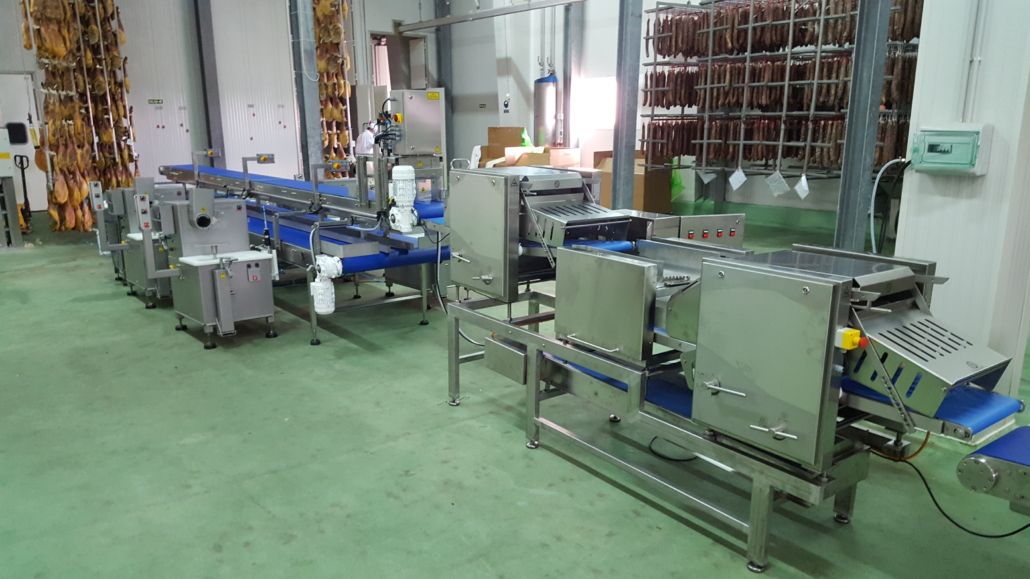
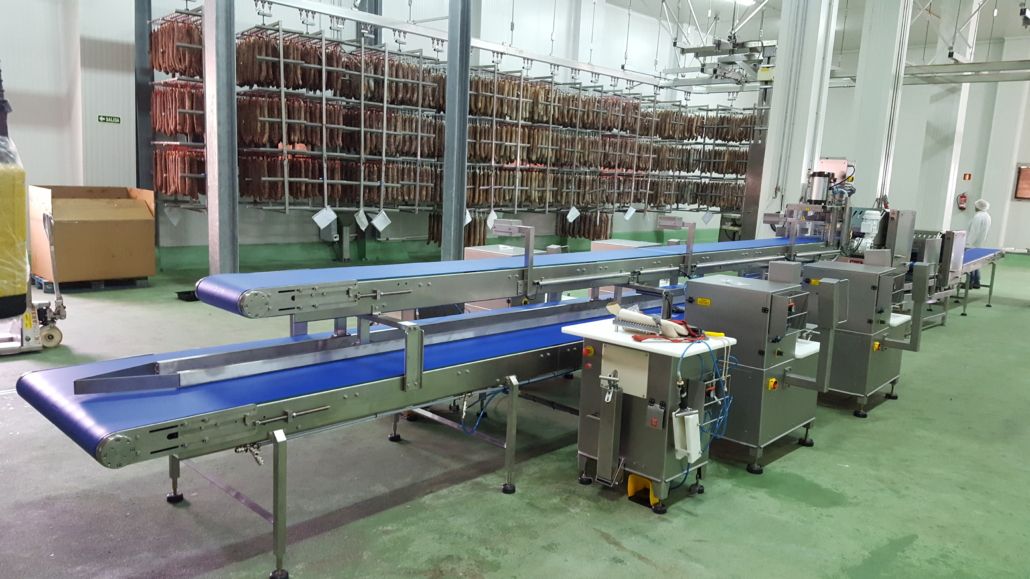
Double-Sided Skinning Lines with Integrated Press and Extractor
CRUELLS double-sided skinning lines are engineered for the automatic processing of both sides of hams and shoulders in a continuous, homogeneous, and robust workflow.
The line combines two automatic double-roller skinners with an intermediate pressing and flipping system, delivering a fully skinned ham on both sides through a simple and highly efficient process.
System Operation / Funcionamiento de la línea
-
Infeed Conveyor with Top Press: (Cinta de entrada con prensa superior). The ham or shoulder is positioned on a conveyor equipped with a press that levels the product surface, stabilizes the piece, and improves the homogeneity of the subsequent cut.
-
First Automatic Skinner: (Primera descortezadora automática). The piece passes through the first unit, where the rind is removed from one side.
-
Gravity Turning System: (Sistema volteador por gravedad). Via a mechanical flipping device, the ham turns automatically in a controlled manner, preparing it for the second-side skinning.
-
Second Automatic Skinner: (Segunda descortezadora automática). The piece enters the second machine to skin the remaining side.
-
Outfeed Conveyor: (Cinta de salida). The fully skinned ham is evacuated, resulting in a uniform finish on both sides, optimizing yield and reducing manual handling.
Industrial Skinning Line for Ham and Shoulder
These lines are specifically designed for:
-
Industrial processing of fresh or cured ham.
-
Continuous skinning of shoulders (paletas).
-
Medium to high-capacity production plants.
-
Facilities seeking consistency and labor reduction.
Customizable Configuration / Configuración personalizable
Each double-sided line can be tailored to specific client needs:
-
Integration of custom conveyor belts.
-
Skin extractor systems. (Sistemas extractores de pieles).
-
Speed adjustments and flow configuration.
-
Adaptation to available plant floor space.
This is a robust, mechanically simple, and easy-to-maintain system, designed to operate in the most demanding environments of the meat industry.